


Why are you paying a full service fee for a dumpster that is only half full? It’s a common frustration for business owners who see their monthly invoices climb while the actual service remains stagnant. You likely feel that your waste bill should be a predictable utility, yet “hidden fees” and surprise surcharges make it feel more like a moving target. We understand that you want to focus on your core operations without being distracted by the logistics of your trash.
If you’re looking for how to reduce commercial waste bill expenses in 2026, you’re in the right place. With landfill rates in some areas spiking by over 50% this year, efficiency is no longer optional. This guide from Freedom Waste Management provides a clear path toward transparency and relief. We’ll show you how to audit your contracts for hidden surcharges, right-size your front load dumpsters, and leverage compaction technology that can reduce waste volume by up to 80%. By the end, you’ll have a streamlined plan to turn your waste handling into a frictionless, predictable part of your budget.
Key Takeaways
- Learn to decode complex waste invoices and identify the specific hidden surcharges that inflate your overhead every month.
- Discover how to select the ideal front load or roll-off dumpster size to ensure you only pay for the volume you actually use.
- Master the strategy of how to reduce commercial waste bill totals by using high-efficiency compactors to cut hauling frequencies by up to 75%.
- Identify red flag clauses in your waste contracts, such as automatic renewals, that prevent you from securing more transparent pricing.
- Transition from unpredictable variable costs to a simplified, upfront pricing model that puts you back in control of your logistics.
Understanding Your Waste Invoice: Why Disposal Costs Are Rising
Your monthly waste bill should be simple. Instead, it often arrives as a dense, multi-page document filled with technical line items that seem designed to confuse. Understanding these charges is the first step in learning how to reduce commercial waste bill costs effectively. Most invoices split costs into three main buckets: hauling fees for the truck’s visit, disposal fees based on weight, and environmental fees for regulatory compliance. When these are bundled together without transparency, it’s difficult to see where your money is actually going.
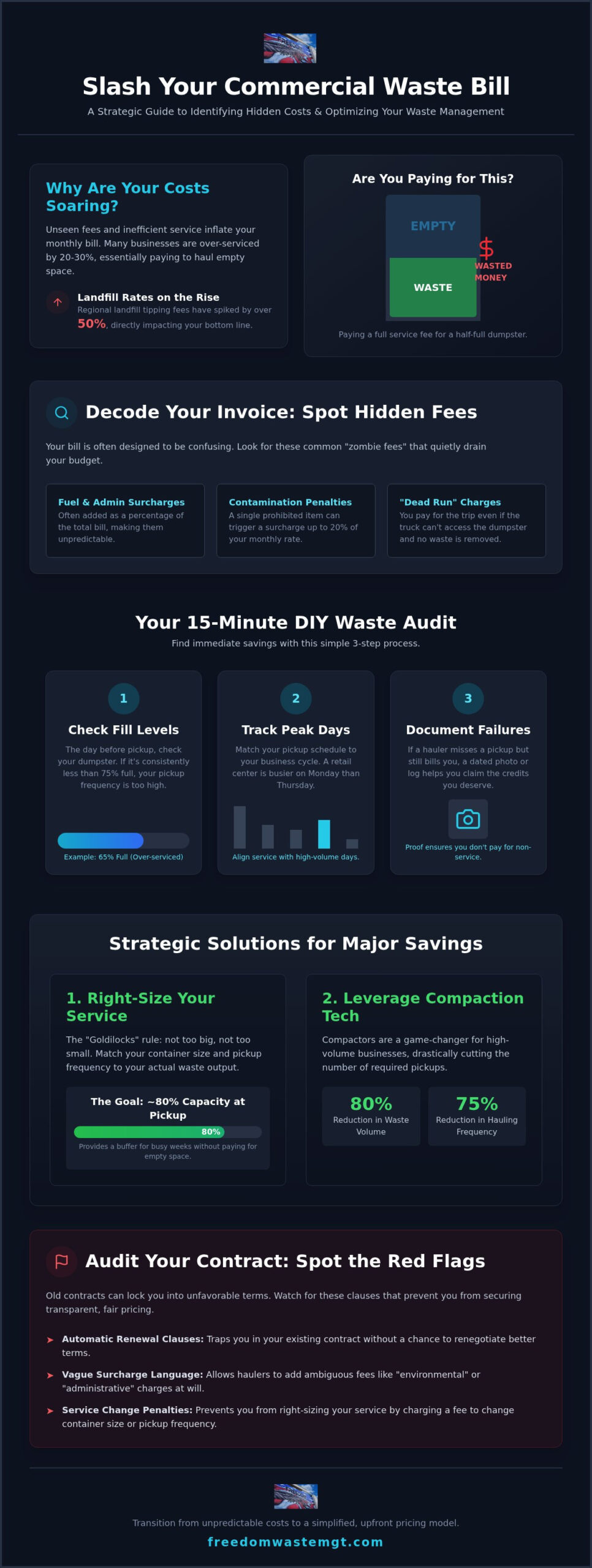
Disposal costs are climbing sharply across the country. In 2026, landfill tipping fees have seen significant jumps; for instance, Orange County, California, implemented a 53% rate increase to $67 per ton. These regional spikes directly impact your overhead. If you aren’t watching your invoice, “zombie fees” like automatic 5% annual rate escalators or administrative surcharges can quietly drain your budget. Many commercial clients are currently “over-serviced” by 20% to 30%. This means you’re paying for a truck to stop and lift a container that is only partially full. You’re essentially paying to haul air.
The Hidden Costs of Traditional Waste Management
Traditional waste contracts are often designed with complexity that benefits the hauler, not the business. Fuel and administrative surcharges are frequently added as percentages of the total bill, making them difficult to predict. Contamination penalties are another common pain point. If a driver spots prohibited material in your front load dumpsters, you might see a surcharge that is 20% of your monthly service rate. Perhaps the most expensive line item is the “dead run.” This occurs when a truck arrives for a scheduled pickup but cannot access the dumpster; you still pay for the trip despite no waste being removed.
Performing a 15-Minute Waste Audit
You don’t need an outside consultant to find immediate savings. A quick 15-minute audit can reveal exactly where your money is going. Start by visiting your commercial dumpsters the day before your scheduled pickup. If the container is consistently less than 75% full, your pickup frequency is too high. You are paying for service you don’t need.
Next, track your “peak waste” days. A retail center might be at capacity on Monday morning after a busy weekend but nearly empty on Thursday. Adjusting your schedule to match these cycles ensures you only pay for actual volume. Finally, document every service failure. If a hauler misses a pickup but still bills you, having a dated photo or log allows you to claim the credits you deserve. This proactive approach is the most direct way to gain transparency and lower your monthly expenses.
Right-Sizing Your Service: Matching Container Volume to Actual Output
After completing your waste audit, you likely discovered that your current equipment doesn’t match your actual output. This is where the “Goldilocks” rule comes into play. If your bin is too large, you’re paying to haul air; if it’s too small, you’re hit with overage fees and extra pickup charges. Finding the size that is “just right” is a fundamental step for anyone researching how to reduce commercial waste bill costs. You want a container that reaches about 80% capacity just as the truck arrives. This provides a buffer for busy weeks without wasting money on empty space.
Calculating the cost-per-cubic-yard is essential for long-term savings. While a 4-yard front load dumpster might have a lower monthly rate than an 8-yard model, the 8-yard bin often provides a better value per unit of volume. However, that value only exists if you fill it. When you’re ready to make a change, approach your provider with your audit data. Showing that your bins are consistently under-filled gives you the leverage to negotiate a service frequency change without triggering contract penalties. If you need help determining which setup fits your footprint, our team provides professional support for right-sizing equipment to ensure you never pay for more than you need.
Choosing Between Front-Load and Roll-Off Bins
Front load dumpsters, ranging from 2 to 8 yards, are the standard for most retail and office environments. They occupy a small footprint and are ideal for consistent, daily waste streams. Roll-off dumpsters are better suited for high-volume operations or construction sites where bulky materials are common. Optimizing your bin placement is just as important as the size. Ensuring a clear, straight path for the truck eliminates “difficult access” surcharges and reduces the labor time your staff spends moving trash across the lot.
Optimizing Pickup Schedules
The math of “on-call” versus “scheduled” pickups depends entirely on your consistency. Scheduled pickups offer predictability, but on-call service can save significant money for businesses with fluctuating volumes. Seasonal businesses should adjust their frequency at least twice a year to match peak and off-peak periods. In 2026, many companies are implementing fullness sensors. These IoT devices monitor your bin levels in real-time and automatically trigger a pickup request only when the container is full, removing the guesswork from your logistics and ensuring every dollar spent on hauling is justified.
The ROI of Compaction: How Compactors Slash Hauling Frequencies
Hauling fees are often the single largest expense on a waste invoice. Every time a truck rolls onto your property, you’re paying for fuel, labor, and equipment time. If you’re still using traditional commercial dumpsters for massive volumes of loose trash, you’re essentially subsidizing the hauler’s fuel bill. Compaction flips this script by condensing waste at the source. Instead of paying for four separate trips to empty a container full of air and loosely packed debris, you pay for one trip that carries the same amount of material in a dense, manageable block.
Understanding the ROI of compaction is a game-changer when looking for how to reduce commercial waste bill totals. While there is an initial investment in the equipment, the reduction in “pull charges” often pays for the unit faster than most business owners expect. In 2026, with landfill tipping fees rising by over 50% in certain regions, minimizing the number of hauls is the most effective way to insulate your budget from price volatility. Fewer trucks on-site also means less wear and tear on your pavement and a significantly lower carbon footprint for your operations.
When Does a Compactor Pay for Itself?
Most businesses assume compactors are reserved for massive industrial plants. That’s a misconception that keeps waste bills high. If your facility generates enough waste to require three or more weekly pickups of a standard front load dumpster, the math shifts in favor of compaction. Beyond the direct billing, consider the hidden labor costs. Employees spend hours every week breaking down cardboard boxes or trekking back and forth to an overflowing bin. A compactor simplifies this workflow, allowing your team to stay focused on high-value tasks. By utilizing a 4:1 compaction ratio, a business can effectively consolidate four standard dumpster loads into a single haul, slashing monthly transportation fees by up to 75%.
Types of Compactors for Different Business Needs
Choosing the right machine is essential for maximum efficiency. Self-contained compactors are the gold standard for restaurants and grocery stores. They are liquid-tight, which prevents leaks and odors associated with wet waste. Stationary compactors are bolted to the ground and are perfect for retail and distribution centers dealing with dry materials like cardboard and plastic. For businesses with limited outdoor space, vertical compactors provide the power of compaction within a footprint similar to a standard dumpster, making them a versatile tool for how to reduce commercial waste bill expenses in crowded urban environments.
Auditing Your Waste Contract: Spotting and Eliminating Hidden Fees
Many businesses treat their waste contract as a “set it and forget it” document. This is a costly mistake. Most national haulers utilize variable contracts that allow for frequent, unannounced price hikes under the guise of “market adjustments.” If you’re serious about how to reduce commercial waste bill expenses, you must transition to an upfront pricing model. This approach eliminates “bill shock” by locking in a transparent rate that doesn’t fluctuate based on a hauler’s internal overhead or shifting fuel costs. A fixed rate provides the predictability your budget needs to stay on track.
Review your current agreement for “Right of First Refusal” clauses. This sneaky language essentially forces you to allow your current provider to match any competitor’s lower offer, effectively trapping you in a cycle of mediocre service. You should also watch for “liquidated damages” provisions, which can require you to pay up to six months of service fees just to cancel your contract. When negotiating a new deal, always request an annual rate cap. This ensures that your costs won’t jump by more than a fixed percentage each year, protecting you from the massive spikes seen in traditional industry contracts. To fully understand what you’re signing, review our detailed breakdown of commercial waste service agreements and how to avoid hidden fees before committing to any provider. At Freedom Waste Management, we believe in transparent billing as a core brand differentiator, ensuring you never face these predatory traps.
The ‘Spot the Surcharge’ Checklist
Ancillary fees are the “silent killers” of a healthy bottom line. Review your latest invoice for these specific red flags:
- Administrative Fees: These are often pure profit for the hauler and should be negotiated to zero.
- Environmental Surcharges: These are frequently applied as a flat percentage of your bill rather than reflecting actual regulatory costs.
- Overweight Fees: Never pay these without a physical weight ticket from a certified scale; if they can’t prove it, don’t pay it.
- Access Fees: Drivers may charge you if they claim they couldn’t reach the bin, but you shouldn’t pay for their convenience if your enclosure was clear.
Switching Providers Without the Stress
Timing your exit is the most critical part of switching. Most contracts require a 60-day or 90-day written notice sent via certified mail before the renewal date. Missing this window can lock you in for another three to five years. When you sign with a new partner, demand a “no-fee” installation and removal agreement. This ensures you aren’t hit with a massive bill just for swapping out your front load dumpsters. Local, transparent partners often beat national brokers on both price and reliability because they are invested in the community’s success, not just a quarterly earnings report.
Streamlining Your Waste Strategy with Freedom Waste Management
Managing your overhead should be simple, yet waste disposal often remains a source of frustration. Freedom Waste Management acts as your frictionless enabler, handling the logistical heavy lifting so you can stay focused on your business goals. We’ve built our reputation on a foundation of reliability and transparency. By choosing a partner that prioritizes upfront pricing, you’re not just hiring a hauler; you’re securing peace of mind. This approach is the most effective way to understand how to reduce commercial waste bill totals without sacrificing service quality.
Our solutions are never one-size-fits-all. We look at the data from your waste audit to provide a customized strategy that aligns with your actual output. Whether you need high-efficiency front load dumpsters or heavy-duty roll-off compactors, our equipment is designed to minimize your footprint and maximize your savings. We also understand that your time is valuable. That’s why we’ve streamlined the administrative side of waste management with hassle-free online scheduling and payment systems tailored for property and facility managers. Your sustainability goals are also our priority. We employ eco-friendly disposal practices that ensure your business remains environmentally responsible while staying profitable.
Customized Equipment Solutions
Our inventory includes a wide range of tools to fit any commercial space. We offer front load dumpsters for daily retail needs and roll-off dumpsters for larger, bulkier waste streams. For those seeking the highest level of efficiency and learning how to reduce commercial waste bill totals through density, our commercial trash compactors are the ideal choice. Every rental includes professional maintenance and hauling services, ensuring your operations never skip a beat. We provide expert guidance to help you through the right-sizing process, making sure your equipment matches your volume perfectly.
Ready to Lower Your Bill?
The journey toward a more predictable waste bill starts with a simple conversation. Our onboarding process is designed to be quick and thorough, beginning with a site audit to determine your specific needs. From there, we handle the equipment installation and transition logistics so you don’t have to. You can receive a transparent, comprehensive quote in minutes that outlines exactly what you’ll pay, with zero hidden surcharges or surprise fees. Take the first step toward a simpler, more affordable waste strategy and Request Your Transparent Commercial Waste Quote Today.
Take Control of Your Waste Logistics Today
Managing your overhead doesn’t have to be a source of constant stress. By right-sizing your equipment and auditing your contracts for hidden surcharges, you can transform your waste handling from a confusing expense into a streamlined operation. You now have the tools. You understand that high-efficiency compactors can reduce your hauling frequency by up to 75%. Learning how to reduce commercial waste bill totals is ultimately about reclaiming transparency in your business partnerships.
Freedom Waste Management is here to be your frictionless ally. We provide upfront pricing with no hidden fees and locally operated expert support that national brokers simply can’t match. Whether you need a simple front load dumpster or an industrial-grade compactor, we customize every solution to fit your specific volume. It’s time to stop paying for “air” and start enjoying predictable monthly costs. Simplify your waste handling and reduce your bill with Freedom Waste Management. You’ve done the hard work of building your business; let us handle the heavy lifting so you can focus on your next phase of growth.
Frequently Asked Questions
How much can I realistically save by switching to a trash compactor?
You can realistically reduce your hauling frequencies by up to 75% by switching to a high-efficiency compactor. Because hauling is the primary driver of your monthly expenses, consolidating four dumpster loads into a single trip provides immediate relief. Consolidating your waste into a dense block is a core strategy for anyone learning how to reduce commercial waste bill totals. Beyond the direct savings, you also reduce the labor time your staff spends managing overflowing bins.
What are the most common ‘hidden fees’ in commercial waste contracts?
Fuel surcharges, environmental fees, and administrative “add-ons” are the most frequent culprits. These charges often hide in the fine print as percentages of your total bill rather than fixed costs. You should also watch for “dead run” fees, which occur if a driver can’t access your bin due to a blocked enclosure. Identifying these surcharges is essential for transparent billing and ensures you only pay for the service you actually receive every month.
How do I know if my dumpster size is too big for my business needs?
If your container is consistently less than 75% full when the truck arrives, your dumpster is too big or your pickups are too frequent. You’re essentially paying a premium to haul empty space. Performing a quick audit by checking fullness levels the day before service helps you identify this waste. Right-sizing your equipment ensures your monthly bill matches your actual output rather than an arbitrary estimate based on outdated business needs.
Can I change my pickup frequency in the middle of a contract?
You can typically adjust your frequency, though you should check your contract for clauses regarding “service level decreases.” Many providers try to charge a penalty for reducing pickups to protect their own margins. However, providing photographic proof that your bins are under-filled gives you strong leverage to negotiate. Adjusting your schedule to match your business’s peak and off-peak cycles is a practical way to lower your monthly overhead without a total equipment overhaul.
Is it better to lease or rent a commercial trash compactor?
Renting is generally the better option for businesses seeking a frictionless experience. When you rent a commercial trash compactor, professional maintenance and hauling support are typically bundled into one predictable monthly payment. This eliminates surprise repair costs and ensures your equipment stays in peak condition. Leasing or buying might offer long-term asset ownership, but it also places the burden of logistical management and expensive repairs squarely on your shoulders.
What happens if my business generates more waste than my current container can hold?
Generating more waste than your container can hold usually triggers “overage fees” or “lid-not-closed” surcharges. These penalties are often significantly higher than the cost of a standard pickup. If your volume has permanently increased, it’s more cost-effective to upgrade to a larger front load dumpster or increase your pickup frequency. This proactive adjustment prevents surprise charges and keeps your property looking clean while maintaining a professional environment for your customers.
How does upfront pricing differ from traditional waste management billing?
Upfront pricing provides a fixed, transparent rate that eliminates the “bill shock” common with traditional variable contracts. In a traditional model, your bill might change every month due to shifting fuel costs or market adjustments. Upfront pricing is a key differentiator for companies looking at how to reduce commercial waste bill volatility. It ensures that the quote you receive is the amount you actually pay, allowing for much better budget predictability and peace of mind.
Do I need a special permit to install a commercial compactor on my property?
You might need a permit depending on your local zoning and building codes. Most commercial trash compactors require a dedicated concrete pad and specific electrical hookups to operate safely. Some municipalities view these as permanent structures, requiring a minor building permit before installation. It’s always best to consult with a local expert who understands regional regulations to ensure your installation is compliant and avoids any potential fines or delays during the setup process.