


How much of your monthly overhead is actually paying for service, and how much is just disappearing into a maze of unexplained surcharges? For many businesses, a commercial waste service agreement feels less like a partnership and more like a legal trap designed to hide price hikes behind complex jargon. You likely signed your contract expecting a simple solution for your dumpsters or compactors, only to find yourself buried under environmental fees and restrictive auto-renewal clauses that keep you stuck for years.
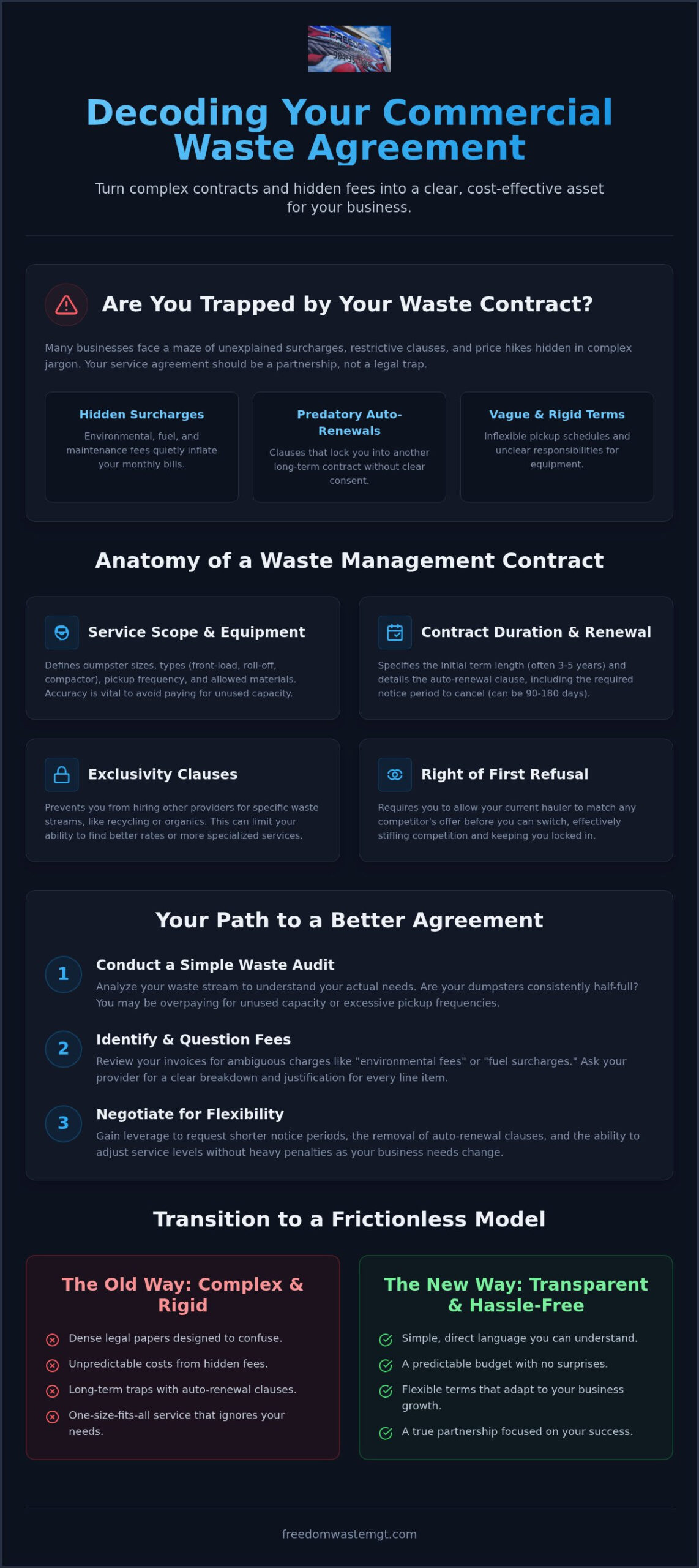
It’s a common frustration, but your waste management shouldn’t be a source of stress. We’re going to help you decode the fine print, avoid those hidden costs, and secure an agreement that actually works for your business. This guide previews the red flags to watch for, explains the impact of shifting regulations like organics recycling mandates, and provides a clear path toward lowering your monthly expenses through transparency and better terms. By the end, you’ll have the confidence to turn a complex obligation into a streamlined, cost-effective asset.
Key Takeaways
- Understand the essential components of a legally binding contract to ensure your service levels match your actual business needs.
- Learn to identify and avoid hidden surcharges that can quietly increase your monthly commercial waste service agreement costs.
- Gain the leverage to negotiate more flexible terms, such as shorter notice periods and the removal of predatory auto-renewal clauses.
- Discover how a simple waste audit can prevent you from overpaying for unused dumpster capacity or excessive pickup frequencies.
- Transition from complex, rigid contracts to a transparent, hassle-free model that prioritizes your business’s growth and peace of mind.
What is a Commercial Waste Service Agreement?
A commercial waste service agreement is a legally binding contract between your business and a waste hauler. It’s the foundation of your disposal strategy. This document outlines everything from pickup frequency and equipment types to the specific pricing structures you’ll follow. While the waste management industry covers a massive global sector, your agreement makes those high-level concepts practical for your local storefront or warehouse. It’s the roadmap that ensures your business stays clean and compliant without you having to manage the details every single day.
It’s vital to distinguish these private agreements from municipal mandates. City rules often set a baseline for safety, but a private contract gives you the power to negotiate terms that fit your specific volume and schedule. This choice matters because it dictates your long-term operational costs and your legal liability. If a contract is vague, you might find yourself responsible for maintenance issues or fee spikes you didn’t anticipate. A clear agreement eliminates that guesswork by putting every expectation in writing.
Why Your Business Needs a Formal Agreement
A formal contract provides the stability your operations require. It ensures consistent service levels, which is essential for maintaining health and safety standards at your facility. When trash doesn’t move, problems grow. By defining clear responsibilities for equipment maintenance and repairs, you protect yourself from unexpected downtime. You’ll know exactly who is responsible if a container starts leaking or a gate won’t close. Most importantly, a solid agreement establishes a predictable budget. You can plan your monthly expenses with confidence, knowing exactly what to expect on every invoice.
The “Frictionless” Approach to Waste Contracts
Modern business moves fast, and your logistics should keep up. A well-structured agreement reduces administrative heavy lifting by clarifying every detail from the start. This approach moves the conversation away from the gritty nature of the industry and toward a clean, optimistic partnership. When you look at your commercial dumpster rental terms, you should see transparency rather than confusion. Trust is built when there’s no friction in the process. By focusing on simple, direct language, a commercial waste service agreement becomes a tool for success rather than a source of frustration. It lets you stay focused on your goals while the logistical heavy lifting happens quietly in the background.
Key Components of a Standard Waste Management Contract
A robust commercial waste service agreement acts as a blueprint for your facility’s cleanliness. It goes beyond simple pickup dates to define the entire relationship between your business and your hauler. While many providers offer a dense stack of legal papers, a transparent contract focuses on four main pillars: service scope, duration, exclusivity, and future rights. Understanding these ensures you aren’t paying for air or getting trapped in a cycle of subpar service.
The service description is where you’ll find details on commercial dumpster rental sizes and specific pickup schedules. Accuracy here is vital. If your volume fluctuates, you need a contract that allows for adjustments without heavy penalties. You should also look for a “Right of First Refusal” clause. This often requires you to let your current hauler match any competing offer you receive, which can stifle your ability to switch to a better partner later. Similarly, check for exclusivity clauses that might prevent you from hiring a separate recycler for specific materials. For those looking to modernize their terms, reviewing the EPA’s Sample Zero Waste Contract Clauses provides a helpful benchmark for what a fair agreement looks like today.
Equipment Specifications and Rental Terms
Your equipment must match your reality. Differentiating between front-load bins for daily trash and roll-off dumpsters for large-scale projects ensures you have the right tool for the job. If you use commercial trash compactors, your agreement should clearly detail installation costs, ongoing maintenance schedules, and hauling fees. Over-provisioning equipment is a common way businesses lose money. We recommend choosing a partner that prioritizes transparent equipment rentals to avoid paying for capacity you don’t actually use.
The “Small Print” Clauses to Watch
The most restrictive parts of a commercial waste service agreement often hide in the fine print. Liquidated damages clauses, for instance, can make breaking a contract early prohibitively expensive. You should also scrutinize indemnification sections, which determine who is liable if an accident happens on your property during a pickup. Finally, review the Force Majeure clause. This defines what happens during service disruptions like extreme weather or labor strikes. A fair contract protects both parties, ensuring that you aren’t left with overflowing bins and no recourse during an emergency.
Identifying and Avoiding Hidden Fees in Your Agreement
Opening a monthly invoice shouldn’t feel like a game of detective work. Many businesses sign a commercial waste service agreement expecting a flat rate, only to see the total climb through a series of “ancillary” charges. These hidden costs often turn a competitive quote into a financial burden. By identifying these line items early, you can negotiate a more transparent partnership that respects your budget and provides the relief you deserve.
Environmental surcharges are a frequent culprit. Instead of a flat fee, haulers often charge a percentage of your total bill. This means every time your base rate goes up, this fee scales with it. Fuel surcharges operate similarly. They allow haulers to pass on fluctuating energy costs directly to you, often without a cap or a clear link to actual market prices. These aren’t just small change; they can represent a significant percentage increase over your original quoted price.
Then there are overage charges. If your bin lid won’t close or your waste exceeds the top rail, you might face a penalty for each occurrence. While some oversight is necessary for safety, these fees should be clearly defined, not used as a “gotcha” for a busy week. Administrative and paperwork fees are another area for scrutiny. In a modern, digital-first environment, these costs should be baked into your base rate. You shouldn’t be charged extra for the simple act of receiving a bill.
The Reality of “Price Creep”
Price creep is the incremental, often unannounced, increase in service rates over the life of a contract. While an annual “cost of living” adjustment might seem small, these increases compound over a typical multi-year term. A professional waste management strategy relies on upfront pricing to prevent this slow drain on your resources. Without a cap on these increases, you’ll likely pay more for the exact same service as time goes on. Transparency is the only way to keep your budget predictable.
Ancillary Costs You Might Not Expect
Beyond the monthly haul, watch for situational costs that add up quickly. These include:
- Container delivery and removal fees that appear when you start or end service.
- Lock fees for bins that require keys or padlocks to prevent illegal dumping.
- “Long carry” charges if the driver has to move the bin a significant distance to the truck.
- Cleaning and deodorizing services to keep your site fresh and professional.
Understanding these costs upfront allows you to choose the right equipment and placement for your facility, ensuring you only pay for the service you actually need.
How to Negotiate and Review Your Waste Contract
Negotiation isn’t just about price; it’s about control. A commercial waste service agreement should be a tool for your success, not a source of administrative stress. Start your review with a thorough waste audit. By tracking your actual trash output over a typical two-week period, you’ll discover if you’re paying for half-empty bins. Many businesses find that adjusting their pickup frequency or bin size immediately lowers their monthly overhead, ensuring they only pay for the volume they actually produce.
The “Auto-Renewal” clause is perhaps the most common trap in the industry. These clauses often renew a contract for several years unless you provide notice within a very narrow window. Push for a 30-day or 60-day notice period instead. This flexibility ensures your provider stays motivated to earn your business every month. You should also request a fixed cap on any annual price adjustments. This simple addition prevents the price creep mentioned earlier from turning into a major budget shock as the years pass.
Choosing between national and local providers requires a balance of service and accountability. While national haulers have massive fleets, local partners often provide the transparency and responsiveness that modern businesses crave. Local providers are more likely to offer a “No Hidden Fees” guarantee in writing because they value their community reputation. This neighborly accountability often leads to cleaner sites, faster response times, and more reliable scheduling that respects your time.
Steps to Take Before Signing
Verify the dumpster size for your business before signing anything. Your industry has specific needs, and a “one size fits all” approach rarely works for complex logistics. Check the “Exit Clause” to ensure you have a clear remedy if service levels drop. A fair contract includes a cure period where the hauler can fix an issue, followed by an easy termination right if they fail to perform. This protects your facility from being stuck with poor service.
When to Consider Switching Providers
Transitioning providers should be a move toward simplicity and relief. If you deal with persistent missed pickups or communication that feels like a dead end, it’s time to move on. Sudden spikes in your invoices or a lack of transparent disposal data are also major red flags. Switching to a partner that values clarity and offers eco-friendly options will save you time and administrative frustration. If your current contract feels like a burden, reach out to our team for a transparent alternative that puts your business first.
The Freedom Waste Advantage: Hassle-Free Agreements
Waste management works best when you don’t have to think about it. We believe your focus belongs on scaling your operations and serving your customers, which is why we’ve built a service model that operates entirely in the background. Freedom Waste Management functions as a frictionless enabler, handling the logistical heavy lifting so you can remain focused on your own goals. We’ve designed our commercial waste service agreement to be the remedy for the industry’s most common frustrations, replacing complex legalese with a clean, optimistic partnership built on trust.
Our commitment to transparency starts with an upfront pricing model. You won’t find the “gotcha” fees or hidden surcharges that we’ve discussed in previous sections. There are no environmental fees that scale with your bill and no unexplained administrative costs. Whether you require front-load dumpsters for daily operations or high-volume commercial trash compactors for industrial output, our rental options remain flexible and direct. We match our equipment to your actual volume, ensuring you never pay for empty space or unnecessary pickups. It’s a professional approach that values your budget as much as your time.
Simplified Handling for Modern Businesses
Modern logistics should be fast and fluid. We offer online scheduling and payments to provide a frictionless experience that respects your schedule. This digital-first approach eliminates the administrative heavy lifting often associated with traditional haulers. We don’t believe in rigid, one-size-fits-all contracts. Instead, we provide customized service plans designed around your specific volume needs. Our team acts as a quiet professional, delivering consistent results and environmentally responsible disposal without the need for constant oversight. You get the reliability of a national partner with the neighborly care of a team that takes pride in the community.
Ready for a Better Waste Solution?
Transitioning to a more transparent commercial waste service agreement is the first step toward long-term peace of mind. You shouldn’t have to settle for “price creep” or unresponsive service. Partnering with a provider that prioritizes your success means you can finally stop worrying about what’s in your trash and start focusing on what’s next for your business. We’re here to provide the streamlined resolution you’ve been looking for, moving your operations from complexity to total simplicity. If you’re ready to experience a waste solution that actually works for you, it’s time to make the switch.
Get a transparent quote for your commercial waste needs.
Secure Your Path to Transparent Waste Management
Managing your facility’s waste shouldn’t feel like a second job. By understanding the core components of a commercial waste service agreement, you’ve gained the tools to protect your budget from unannounced price hikes and restrictive clauses. You now know how to spot hidden surcharges and negotiate for the flexibility your business deserves. This knowledge transforms a complex legal obligation into a streamlined part of your daily operations that supports your growth rather than hindering it.
The transition from frustration to relief starts with choosing a partner that values transparency as much as you do. We provide reliable commercial dumpster and compactor rentals backed by an upfront pricing model that eliminates “gotcha” fees. With our frictionless online scheduling and payments, your waste handling becomes a quiet, behind-the-scenes success. Simplify your business waste with a transparent service agreement from Freedom Waste Management. You’ve done the hard work of building your business; let us handle the heavy lifting so you can keep moving forward with total peace of mind.
Frequently Asked Questions
How long is a typical commercial waste service agreement?
Typical length is three to five years. Haulers often push for these extended terms to secure their route density and equipment investments. You don’t have to accept these long commitments. Negotiating for a one-year term or a month-to-month arrangement provides the relief you need to stay agile as your business grows.
Can I negotiate the terms of a waste management contract?
Negotiation is a standard part of securing a fair commercial waste service agreement. You can request changes to price increase caps, notice periods, and equipment maintenance responsibilities. A transparent partner will work with you to ensure the contract reflects your actual operational needs rather than just their corporate requirements. This proactive approach builds a foundation of reliability and trust from day one.
What is an “auto-renewal” clause in a trash contract?
An auto-renewal clause automatically extends your contract for a new term, often three years, if you don’t cancel within a specific timeframe. These windows are usually hidden in the fine print and require certified mail notification months in advance. It’s a strategy designed to keep you locked into a service even if your needs have changed or the pricing has become unsustainable.
What are the most common hidden fees in waste management?
Environmental surcharges and fuel adjustments are the most frequent hidden costs that inflate your monthly invoice. You might also encounter administrative fees for digital billing or overage charges for bins that are slightly overfilled. A solution-oriented provider eliminates these gotcha moments by offering upfront pricing that covers the total cost of your service without any unexplained surprises or frustrating line items.
How much notice is required to cancel a commercial waste agreement?
Traditional haulers usually demand 60 to 180 days of written notice before the contract expires. If you fail to send this notice via the correct method, the agreement might renew automatically for several years. We recommend pushing for a 30-day notice period. This change gives you the freedom to move toward a more streamlined resolution if your current provider fails to meet expectations.
What happens if I need to change my pickup frequency mid-contract?
Most agreements allow for frequency changes, but some haulers use these requests to trigger a contract extension or a price hike. You should ensure your contract includes a right to adjust clause that lets you scale service up or down based on your actual volume. This flexibility ensures your waste management remains invisible and efficient, allowing you to focus on your business goals.
Is it possible to have a month-to-month waste service agreement?
While multi-year contracts are the industry norm, month-to-month options are available through modern, digital-first providers. This structure removes the friction of long-term legal traps and places the burden of performance on the hauler. If the service isn’t reliable and professional, you have the immediate freedom to switch. It’s the ultimate way to ensure your commercial waste service agreement actually works for you.
What is a “Right of First Refusal” clause?
This clause requires you to show your current hauler any competing quotes you receive before you can switch. It gives them the chance to match the price and keep your business legally. While it sounds fair, it actually limits your choices and prevents you from moving to a partner that offers better technology, cleaner equipment, or more responsive customer support during your growth.