


A dumpster that is too small isn’t just a logistics headache; it is a direct threat to your brand’s professional image and your monthly bottom line. You have likely felt the frustration of spotting unsightly trash overflows in the parking lot or opening a bill only to find unexpected overage fees that weren’t in the budget. It’s a common struggle for leaders who want their waste management to be invisible and efficient.
Mastering how to choose dumpster size for business is the key to turning that chaos into a streamlined operation. By right-sizing your service, you can eliminate hidden costs, avoid smelly overflows, and ensure your exterior remains clean and professional. We will guide you through the differences between front-load and roll-off options, help you assess your volume needs, and show you how to secure a predictable, frictionless waste partnership that respects your space and your schedule. This guide provides the clarity you need to handle the logistical heavy lifting so you can stay focused on your goals.
Key Takeaways
- Learn how to choose dumpster size for business to avoid the financial sting of overage fees and paying for empty space in an oversized container.
- Discover the critical differences between permanent front-load service and temporary roll-off dumpsters to match your equipment to your project’s scale.
- Master the “weekly yardage” calculation to balance pickup frequency with container size, ensuring a clean parking lot and predictable costs.
- Tailor your waste strategy to your specific industry, whether you’re managing bulky retail cardboard or heavy restaurant waste.
- Eliminate logistical headaches with transparent, upfront pricing that removes the friction of hidden fees and complicated contracts.
Understanding Commercial Dumpster Sizes: The Fundamentals
Your business operates on efficiency, and your waste management should be no different. Choosing a container isn’t just about finding a place for trash; it’s about optimizing your overhead and protecting your brand’s reputation. When you begin Understanding Commercial Dumpster Sizes, you’ll find that the industry operates on the “cubic yard” as the standard unit of volume. One cubic yard measures three feet long by three feet wide by three feet high. Mastering this measurement is the first step toward a frictionless waste strategy that keeps your property clean and your costs predictable.
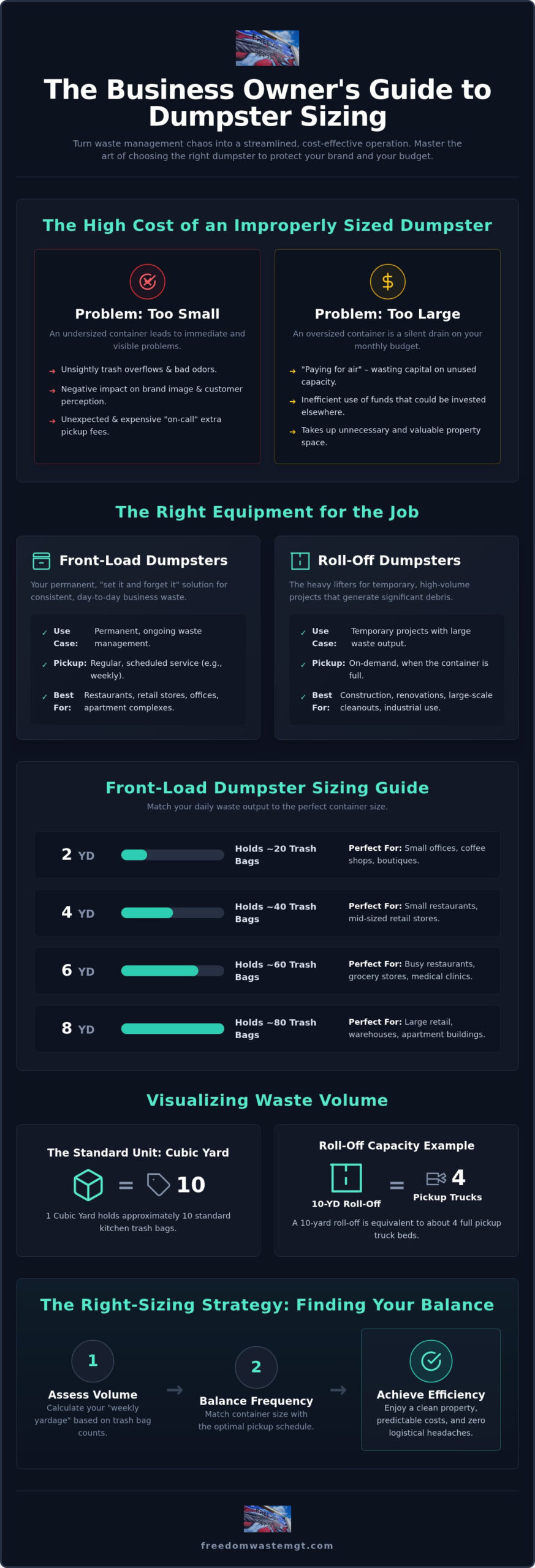
Commercial containers generally fall into two primary categories: Front-Load and Roll-Off. Front-load dumpsters are the permanent fixtures you see behind restaurants or retail shops, designed for consistent, scheduled pickups. Roll-off dumpsters are larger, open-top containers delivered for temporary projects like renovations or industrial cleanouts. Learning how to choose dumpster size for business requires balancing these physical dimensions with your specific waste output to ensure your operations remain uncluttered and professional.
The Impact of Volume on Your Bottom Line
Miscalculating your waste volume creates immediate financial friction. If you under-size your container, you face unsightly overflows and the high cost of “on-call” extra pickups that disrupt your budget. Conversely, over-sizing means you’re “paying for air,” essentially wasting capital on capacity you never use. Right-sizing is the precise intersection where your waste volume meets the most cost-effective pickup frequency. It transforms a messy logistical hurdle into a predictable monthly expense. For customer-facing businesses, this balance is even more critical. A clean, odor-free exterior builds trust with your clients, while an overflowing bin sends the wrong message before they even walk through your door. If your invoices have been climbing despite stagnant service levels, learning how to reduce your commercial waste bill through smarter right-sizing and contract audits can deliver immediate savings.
Visualizing Cubic Yards in Business Terms
Visualizing volume helps you make an informed decision without needing a tape measure. For smaller front-load dumpsters, a simple rule of thumb is that one cubic yard holds roughly 10 standard trash bags. If your small office generates 20 bags a week, a 2-yard container is your likely starting point. When considering larger roll-off containers for heavy projects, think in terms of pickup truck loads. A 10-yard roll-off is roughly equivalent to four pickup truck beds filled to the brim.
Space constraints also play a major role in your choice. You must consider the physical footprint on your property and the overhead clearance required for the truck to safely service the bin. A container that fits your volume but blocks your delivery lane or fire exit creates new problems. Focus on finding the size that handles your output while remaining a quiet, behind-the-scenes facilitator of your daily success.
Front-Load vs. Roll-Off: Selecting the Right Equipment
Choosing the right equipment is about more than just volume; it is about the rhythm of your daily operations. If you need a permanent, “set it and forget it” solution for recurring waste, Front Load Dumpsters are the industry standard. These containers are designed for consistency, fitting neatly into enclosures or alleyways for weekly pickups. On the other hand, Roll-Off Dumpsters serve as the heavy lifters for temporary high-volume projects, such as office renovations or seasonal warehouse cleanouts. Learning how to choose dumpster size for business requires matching your waste stream to the physical capabilities and footprint of these specific containers.
Before you commit to a size, evaluate your site’s physical constraints. Roll-off trucks require significant overhead clearance and a long, flat stretch of pavement to safely deploy a bin. If your property has low-hanging power lines or tight corner turns, a standard front-load container is often the more feasible choice. You want a waste partner that acts as a frictionless enabler, not one that blocks your delivery docks or creates a safety hazard in your parking lot.
Front-Load Dumpster Size Chart (2 to 8 Yards)
- 2-Yard Dumpster: This compact bin is perfect for small offices, boutiques, or businesses with minimal daily waste. It fits in tight spaces and typically holds about 20 large trash bags.
- 4-Yard to 6-Yard Dumpster: These sizes represent the “sweet spot” for mid-sized retail shops and restaurants. They provide enough capacity to handle a mix of cardboard and general waste without requiring daily truck visits.
- 8-Yard Dumpster: This is the largest standard front-load option. It provides heavy-duty capacity for supermarkets, large apartment complexes, or industrial facilities that generate significant volume every day.
When to Upgrade to a Commercial Trash Compactor
Many growing businesses reach a tipping point where traditional dumpsters no longer make sense. If your staff is constantly breaking down mountains of cardboard or if you are scheduling three or more pickups every week, Commercial Trash Compactors offer a superior alternative. These machines use a powerful hydraulic press to crush waste, which significantly reduces the total volume and the number of required pickups. This transition reduces traffic on your property and can lower your long-term monthly expenses.
Compactors also provide a cleaner solution for businesses concerned with odor control or security. Because the waste is contained in a sealed unit, it is less likely to attract pests or unauthorized dumping. Adhering to the rigorous safety and operational standards of the National Waste & Recycling Association, Freedom Waste Management maintains a fleet of high-quality equipment designed for reliability. If you are ready to streamline your operations and eliminate the headache of overflowing bins, you can explore our range of Front Load Dumpsters to find your perfect match.
Sizing Guide by Industry: What Does Your Business Need?
Every industry leaves a unique waste fingerprint. A boutique law firm produces vastly different materials than a local bakery or a small-scale manufacturing plant. When you are learning how to choose dumpster size for business, you must look beyond the total volume of trash and consider the density, weight, and type of materials your staff handles daily. Finding the right fit prevents you from paying for empty space or struggling with bins that reach capacity long before your next scheduled pickup. It’s about creating a waste management plan that acts as a quiet professional in the background of your operations.
Manufacturing and industrial facilities often deal with bulky scrap and high-density materials that require specialized attention. In these environments, a standard front-load container might fill up too quickly with heavy offcuts or packaging, making choosing the right waste container for your business a matter of balancing physical size with weight capacity. For these high-output sites, larger roll-off containers or industrial compactors often provide the most frictionless solution for maintaining a clear and safe production floor.
The Restaurant Waste Challenge
In the food service industry, weight often matters more than physical volume. Food waste is heavy, wet, and prone to rapid decomposition. If you manage a small cafe, a 2-yard bin might suffice, but high-volume fast-food locations typically require at least a 4-yard to 6-yard container. You must prioritize pickup frequency over bin size to manage odors and maintain sanitary conditions. It’s better to have a smaller bin emptied three times a week than a massive 8-yard container sitting for seven days, especially during summer months when heat accelerates waste issues.
Retail and Office Benchmarks
Retail stores and office buildings have more predictable waste streams, often dominated by paper and cardboard. For standalone retail shops, the volume of packaging materials can be deceptive. A 6-yard dumpster is often the standard to account for bulky shipping boxes. However, if your business implements a robust recycling program, you can often downsize your primary trash container. Offices can frequently estimate their needs based on employee count; a general rule is one yard of capacity for every 20 to 25 employees. If you are part of a strip mall with shared containers, ensure your contribution doesn’t exceed your allotted share, as this often leads to friction with neighboring tenants and unexpected fee increases. Before signing any service agreement, it pays to understand your commercial waste service agreement in detail so you can identify hidden surcharges and auto-renewal clauses that could lock you into unfavorable terms.
The Math of Frequency: Balancing Size and Pickup Schedule
Finding the right container is only half the battle. You must also determine how often that container needs to be emptied to maintain a clean property. This balance is where you truly master how to choose dumpster size for business. The math is simple: your weekly yardage is your total waste volume divided by the number of pickups. For example, a 2-yard bin serviced three times weekly provides the same six yards of capacity as a 6-yard bin emptied once. However, the smaller bin requires more frequent truck visits, which might increase traffic on your property. Conversely, the larger bin takes up a bigger physical footprint. If your parking lot is tight, the higher frequency with a smaller container is often the most frictionless choice.
Planning for seasonal fluctuations is equally important. Many businesses experience peak periods during the holidays or summer months when waste volume can double. Instead of permanent upgrades that leave you paying for empty space in the off-season, consider a strategy that accounts for these spikes. A quiet professional approach involves monitoring your levels during these peaks and adjusting frequency temporarily. This proactive management ensures your exterior remains professional without the need for a massive, space-consuming 8-yard bin year-round.
Avoiding the Hidden Costs of Overage Fees
An overfilled dumpster is more than just an eyesore; it is a safety hazard and a primary trigger for extra fees. Most contracts define “overfilled” as any waste protruding above the rim or preventing the lid from closing securely. When lids can’t close, pests move in and debris can spill during transit. By right-sizing your container and schedule, you eliminate the risk of “bill shock” at the end of the month. Transparent pricing models rely on this accuracy, ensuring your waste expenses remain predictable and manageable. If you find your lids are constantly propped open, it’s time to re-evaluate your service level before the fees accumulate. Businesses looking to take a more proactive approach can explore practical strategies to reduce their commercial waste bill by auditing hidden surcharges and leveraging compaction technology.
Evaluating Site Access and Placement
Your property’s layout often dictates your equipment options. Front-load and roll-off trucks require significant overhead clearance, typically at least 14 feet, to operate safely. You must also ensure that gates, enclosures, and parking lot pavement can handle the heavy weight of the truck and a full container without cracking. Safety is paramount in shared commercial alleys or pedestrian-heavy areas. A bin placed in a blind spot or blocking a fire exit creates liability. When you work with a reliable partner, these logistical details are handled for you, ensuring your waste management remains a behind-the-scenes facilitator of your business success. If you’re ready to find a solution that fits your specific footprint, Get started with Freedom Waste Management today.
Streamlining Your Waste with Freedom Waste Management
Managing your waste shouldn’t be a source of constant stress or unexpected costs. At Freedom Waste Management, we’ve built our service to be the quiet facilitator of your business success. We understand that transparency is the foundation of a strong commercial partnership. That is why we provide upfront pricing with no hidden surprises or fees. You get the predictability your budget requires and the reliability your property deserves. Our eco-friendly approach simplifies your environmental compliance, allowing you to focus on growth while we handle the logistical heavy lifting. With intuitive online scheduling and payment tools, managing your account is as efficient as the services we provide.
Choosing a partner with a national service scope and a local commitment to reliability ensures your operations never skip a beat. We combine the resources of a large-scale provider with the neighborly care of a local professional. This hybrid approach means your bins are serviced on time, every time. Mastering how to choose dumpster size for business is easier when you have an expert ally to guide the process. We move quickly from identifying your specific pain points to presenting a streamlined resolution that respects both your time and your property. Part of that expertise includes helping you review your commercial waste service agreement to ensure you’re protected from restrictive auto-renewal clauses and unexplained environmental surcharges that inflate your monthly overhead.
A Frictionless Transition to Better Service
Switching to a more reliable provider is a simple, stress-free process. We begin by helping you audit your current waste output to identify sizing efficiencies you might have missed. If you are still analyzing how to choose dumpster size for business, our experts evaluate your volume and pickup frequency to find the perfect fit. This transition moves your operation from the frustration of overflows to the relief of a streamlined system. We handle the coordination and logistics so you don’t have to. The result is a clean exterior and a waste management plan that works in the background of your daily success.
Comprehensive Equipment Solutions
Our equipment solutions are designed to grow alongside your company. Whether you need compact 2-yard bins for a boutique startup or industrial compactors for a high-output manufacturing facility, we provide the tools to match your scale. Every client benefits from a dedicated account manager who understands the unique waste challenges of your specific industry. This personalized oversight ensures your service remains frictionless and proactive as your needs evolve over time. Request your frictionless waste assessment today at freedomwastemgt.com.
Optimize Your Business Operations Today
You have learned that effective waste management is more than just a bin in the parking lot; it’s a strategic component of your business’s efficiency and curb appeal. By mastering how to choose dumpster size for business, you move from the stress of overflowing containers and hidden fees to a state of predictable, orderly logistics. Whether you are balancing pickup frequency for a high-volume restaurant or selecting a heavy-duty compactor for industrial needs, the right choice protects your bottom line and your brand’s reputation.
Freedom Waste Management is here to serve as your behind-the-scenes facilitator. We prioritize your peace of mind with upfront pricing, easy online scheduling, and eco-friendly disposal solutions that simplify your environmental compliance. You shouldn’t have to worry about the gritty details of waste removal when you have a reliable, quiet professional on your team. It is time to replace logistical headaches with a streamlined partnership that respects your space and your schedule.
Get a Transparent Quote for Your Business Dumpster Rental and start your journey toward a cleaner, more efficient facility. Your business deserves a partner that removes hurdles rather than creating them. We look forward to helping your operation grow.
Frequently Asked Questions
How do I know if I need a 4-yard or a 6-yard dumpster for my retail store?
Base your decision on your weekly cardboard output and delivery schedule. A 4-yard dumpster typically handles standard retail needs, but a 6-yard container is better if you manage high volumes of packaging materials from daily shipments. If you find your lids won’t close before pickup day, upgrading to the larger size prevents unsightly overflows and keeps your storefront looking professional and inviting to customers.
What is the most common dumpster size for a small restaurant?
The 2-yard and 4-yard front-load dumpsters are the most frequent choices for small cafes and restaurants. While a 2-yard bin is compact, it requires more frequent pickups to manage heavy food waste and odors effectively. Selecting the right frequency is just as important as the physical size, ensuring your waste management remains a behind-the-scenes facilitator of your daily kitchen operations without causing disruptions.
Can I change my dumpster size if my business waste increases?
Yes, your waste service should grow alongside your business as your needs evolve. If you have been researching how to choose dumpster size for business and realize your current bin is too small, you can easily adjust your equipment or pickup frequency. We help you audit your waste stream to ensure a frictionless transition to a larger container or a commercial trash compactor as your production scales.
How many trash bags can fit in an 8 cubic yard dumpster?
An 8-yard dumpster can hold approximately 80 standard large trash bags. This heavy-duty capacity makes it ideal for large apartment complexes or supermarkets that generate significant daily volume. Visualizing this capacity helps you avoid paying for air in an oversized bin or facing the frustration of an undersized container that cannot handle your peak waste periods during busy seasons.
What happens if my dumpster is overfilled or too heavy?
Overfilled dumpsters often trigger additional fees and can lead to missed pickups for safety reasons. When waste protrudes above the rim, it prevents the truck from safely securing and lifting the bin during the collection process. To maintain a clean exterior and avoid bill shock, it’s critical to monitor your levels and right-size your service before your trash reaches a tipping point that impacts operations.
Do I need a permit to place a commercial dumpster on my property?
Most businesses don’t need a permit if the dumpster is placed on private property, such as a parking lot or a designated enclosure. However, if the container must sit on a public street or sidewalk, local municipal permits are typically required. We recommend checking your local zoning laws to ensure your placement remains compliant and doesn’t block essential fire exits, delivery lanes, or pedestrian walkways.
How often should a commercial dumpster be picked up to avoid odors?
Food service businesses should schedule pickups at least two to three times per week to effectively manage odors and pests. For offices or retail stores with mostly dry waste, a weekly schedule is often sufficient. The goal is to find a pickup rhythm that keeps your property professional and sanitary without creating unnecessary truck traffic or logistical friction in your daily routine and customer experience.
Is a trash compactor better than a dumpster for a large warehouse?
A commercial trash compactor is often superior for warehouses that handle high-density waste like cardboard, plastic film, or pallet scraps. Compactors crush materials to reduce their total volume, which leads to fewer pickups and lower monthly expenses. This equipment is a smart investment for businesses with limited outdoor space that need to maximize their waste capacity without cluttering their loading docks or production areas.